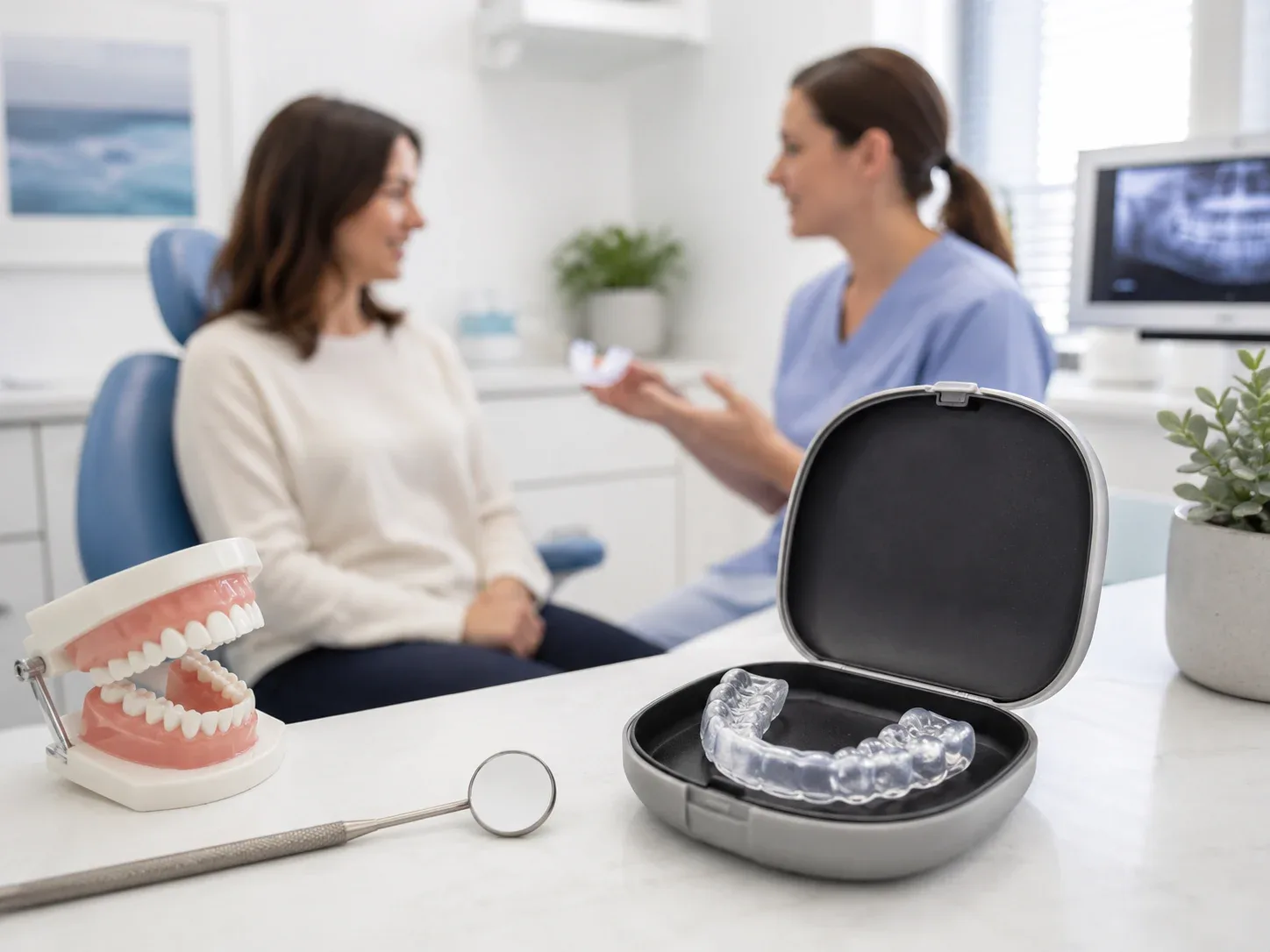
Most people who end up with a mouth guard for clenching had no idea they were doing it until their dentist showed them the wear patterns on their teeth. Clenching doesn’t make noise the way grinding does, so it flies under the radar for years. But it’s one of the more common causes of jaw soreness, cracked enamel, and those headaches you wake up with and can’t quite explain.
Jump to Section
What Jaw Clenching Actually Is
Bruxism is the clinical term for teeth grinding and clenching, and it covers two related but mechanically different habits. Understanding which one you have matters, because they damage teeth through different mechanisms and respond to treatment in different ways.
Clenching is a sustained, vertical compression force. Your upper and lower teeth press together and hold. There is no movement, just pressure, sometimes for seconds at a time and sometimes for much longer. Grinding, by contrast, involves lateral friction: the teeth slide back and forth or side to side against each other. Grinding wears down enamel through friction. Clenching stresses the internal structure of the tooth, the root, the jaw joints, and the surrounding muscles through sheer compressive load.
Because clenching produces no sound, most people have no idea they do it. A partner might notice grinding at night because it is audible. Clenching is silent. It can go on for months or years before a dentist sees evidence of it in the wear patterns on your teeth.
Clenching happens both during the day and at night, and the triggers differ considerably. Daytime clenching is usually stress-related: a hard conversation, a tense meeting, or just deep focus on something difficult. Clenching during workouts is also common, often without any awareness it is happening. Sleep clenching is different. Because you are not consciously controlling your jaw muscles, the force can actually be stronger than anything you would do while awake. According to StatPearls on the NCBI Bookshelf, awake bruxism affects somewhere between 22 and 31 percent of adults.
Is Clenching the Same as Grinding?
Clenching and grinding are related but mechanically distinct habits that both fall under the bruxism umbrella and often coexist in the same patient.
Grinding creates surface wear that shows up as smooth, flattened facets across the biting edges of teeth. Clenching creates more internal stress: microfractures in enamel, root stress, and muscle fatigue that shows up as soreness and tension rather than visible surface loss. A patient who only clenches may have teeth that look relatively intact while still experiencing significant jaw pain. If you have been told you might need a mouth guard for grinding teeth, know that Dean Dental Solutions evaluates for both, because the overlap is common and the right approach depends on which habit is actually driving the damage.
The Signs That You Might Be Clenching
Most people who clench at night have no idea they are doing it. Grinding is loud enough that a partner in the same room will hear it, but clenching is completely silent. There is no sound, and no sensation you would register in the moment. The first signal is usually something vague on waking: a jaw that feels stiff, a headache that arrived without explanation.
Jaw soreness is the one most people notice first, followed by that tight, heavy feeling around the temples and headaches that have no obvious cause. Tender or sensitive teeth are part of it too, and this surprises many patients because there is no cavity, no infection, nothing on an x-ray to explain it. What is actually happening: hours of sustained pressure moving through your jaw while you slept, with nowhere for that pressure to go.
Most people have no idea they clench during the day until a coworker mentions it, or they catch themselves mid-meeting with their teeth pressed together. It tends to happen during concentrated work or a long stretch at the screen, the kind of low-grade mental strain that doesn’t feel stressful in the moment. The jaw just holds. No grinding, no drama, no conscious decision to tighten up. If any of that sounds familiar, mention it at your next visit. It tells us something useful.
How Do I Know If I Clench at Night?
Morning symptoms are the primary clue. Jaw soreness on waking, temple headaches, and teeth that feel sore without any obvious dental cause are the pattern to watch. A dentist can confirm it by looking for wear patterns on your tooth tips, small cracks in the enamel, and indentations along the sides of your tongue where it has been pressing against your teeth during sleep. Those physical signs tell a clear story about jaw clenching during sleep that you cannot observe on your own.
What Clenching Does to Your Teeth Over Time
The damage from clenching comes down to the kind of force involved. When you clench, the pressure is compressive and vertical, driving your upper and lower teeth directly into each other with sustained load rather than the brief, intermittent forces of chewing. Teeth handle that kind of on-and-off pressure without much trouble. Hours of continuous compression, repeated every night, is a different story entirely.
At the enamel level, the first sign is micro-fractures. These are small structural cracks that are invisible at first and then gradually become visible. The biting edges of teeth begin to flatten and shorten. As enamel thins, the pulp inside the tooth sits closer to the surface, which is why clenchers often develop sensitivity to temperature and sweets that wasn’t there before. The roots can also be affected: sustained force transfers down through the tooth and into the surrounding bone, contributing to gum recession over time.
Your teeth are not the only structures absorbing this load. The temporomandibular joint takes on a significant share of force when you clench, and that load spreads. The muscles around the joint tighten up, and that tension travels: up into the neck, across the shoulders, sometimes as a low-grade ache that feels completely unrelated to your mouth. The connection often goes unrecognized for months.
Can Clenching Actually Crack a Tooth?
Sustained clenching generates forces teeth were not built to absorb repeatedly, and micro-fractures are a predictable result. Stress lines that begin as invisible cracks in the enamel can develop into visible fractures over months or years of continued pressure. Per the Cleveland Clinic, sleep bruxism causes more damage than daytime habits precisely because it is unconscious. You have no ability to regulate the force. The effects of grinding and clenching on teeth accumulate slowly, which is part of why people are often surprised by how much wear has built up by the time they notice something is wrong.
How a Mouth Guard Helps With Jaw Clenching
A mouth guard, sometimes called a night guard or occlusal splint, works by placing a durable barrier between your upper and lower teeth so they cannot make direct contact while you clench. Instead of concentrating that force at specific tooth-to-tooth contact points, the guard spreads it across the entire surface of the appliance. This matters because repeated, concentrated pressure is what drives enamel wear, micro-fractures, and strain on the jaw joint over time.
There is another thing the guard does that people do not always expect: it holds your jaw in a slightly more favorable resting position. A small shift in alignment, but it takes real pressure off the joint and gives the surrounding muscles room to settle. For many patients, that shift is what begins reducing the morning soreness and the headaches they had been waking up with.
One point worth stating directly: the guard is not a habit-breaker. It absorbs and redistributes the forces clenching creates, which is real and meaningful protection, but the clenching itself keeps happening. Many patients come in hoping the appliance will train them out of it, and that hope makes sense, but protection and habit change are two separate problems. The guard solves one of them, and knowing which one means you walk in with a clear picture of what you are actually getting.
If you clench and also snore or wake up feeling unrefreshed, it is worth raising with your dentist at the evaluation. Some clenchers also have sleep-disordered breathing, and a dental visit can screen for both. Dean Dental Solutions offers sleep apnea treatment and can help determine whether the two issues are connected in your case.
Will a Mouth Guard Stop Me From Clenching?
A mouth guard is designed to absorb and redistribute the forces your jaw generates, not to eliminate the clenching habit itself. The goal is to ensure your teeth, enamel, and jaw joints are not bearing the full impact night after night. Addressing the underlying clenching habit, if that is the goal, typically involves other approaches such as stress management or physical therapy. The guard handles protection while that longer-term work happens.
Why a Dentist-Fitted Guard Works Better Than a Store-Bought One
Fit is what separates a custom guard from a store-bought one, and fit matters more for clenching than for almost any other guard use.
Research published on the NCBI Bookshelf via StatPearls notes that soft over-the-counter guards can actually increase clenching in some people. The softness triggers a reflexive bite response, so the guard intended to protect your teeth may be prompting more of the behavior you are trying to manage.
Because the guard starts from an exact mold of your teeth and bite, forces spread evenly across the whole surface rather than concentrating at spots where a loose fit leaves gaps. Your jaw can settle into a neutral position instead of working around an appliance that does not fit right. Material thickness matters too: for heavy clenchers, a dentist selects a density matched to the actual force you generate, something a boil-and-bite guard simply cannot replicate.
Your dentist can also adjust a custom guard over time if your bite shifts or if the guard is not providing adequate relief. That kind of ongoing calibration is not possible with a one-size product.
How Long Does a Custom Mouth Guard Last?
Three to five years is typical with regular care, and many patients exceed that range. At your routine checkups, your dentist can see how the guard is holding up and flag when it is starting to wear down in ways that affect the fit. Rinsing it after use and keeping it in its case when you are not wearing it extends the lifespan considerably.
Ready to Get a Mouth Guard for Clenching? Here Is What to Expect at Dean Dental Solutions
Most people do not realize they clench until something forces them to stop and think about it. There is no sound a partner hears, no obvious moment that prompts a mention at a checkup. The signs tend to arrive separately: enamel wearing down on the back teeth, a jaw that feels stiff by morning, a headache that is already there before the day starts. None of those things shouts “nighttime clenching.” By the time someone makes that connection, the habit has usually been running in the background for quite a while.
Dean Dental Solutions has offered custom-fitted mouth guards as part of family dentistry in North Little Rock for more than 30 years, and the starting point is always an actual evaluation. The team looks at jaw position, muscle tension, and wear patterns together before anything gets recommended. If a guard is not the right answer for your situation, they will tell you that.
What Happens at a Mouth Guard Evaluation at Dean Dental Solutions?
Most people walk in not quite sure what to expect. The team starts by listening: when did you start noticing symptoms, what seems to make things worse, how long has this been going on. Then they examine your teeth and jaw to get a clear picture of what is actually happening. If a custom guard makes sense, the team will take an impression or a quick digital scan of your bite. That step matters more than it sounds. The fit is calibrated to your specific bite, not built around some average that may not match you at all. Once your guard is ready, a short follow-up gets scheduled to make sure it feels right and to dial in any minor adjustments before you leave.
Signs It Might Be Time to Schedule an Evaluation
If two or three of these feel familiar, it is worth raising with the team at Dean Dental Solutions.
- Morning jaw soreness or stiffness that eases as the day goes on
- Frequent headaches that start near the temples
- A partner has noticed jaw sounds or tension at night
- Your dentist has pointed out flat or worn tooth surfaces
- You regularly catch yourself clenching during the day, especially under stress
You can request an appointment online, or call us during office hours.
Dean Dental Solutions | North Little Rock, AR
Main: 501-214-4056 | West: (501) 443-7833
Monday–Thursday: 7am–4pm | Friday: 7am–1pm


Leave a Reply