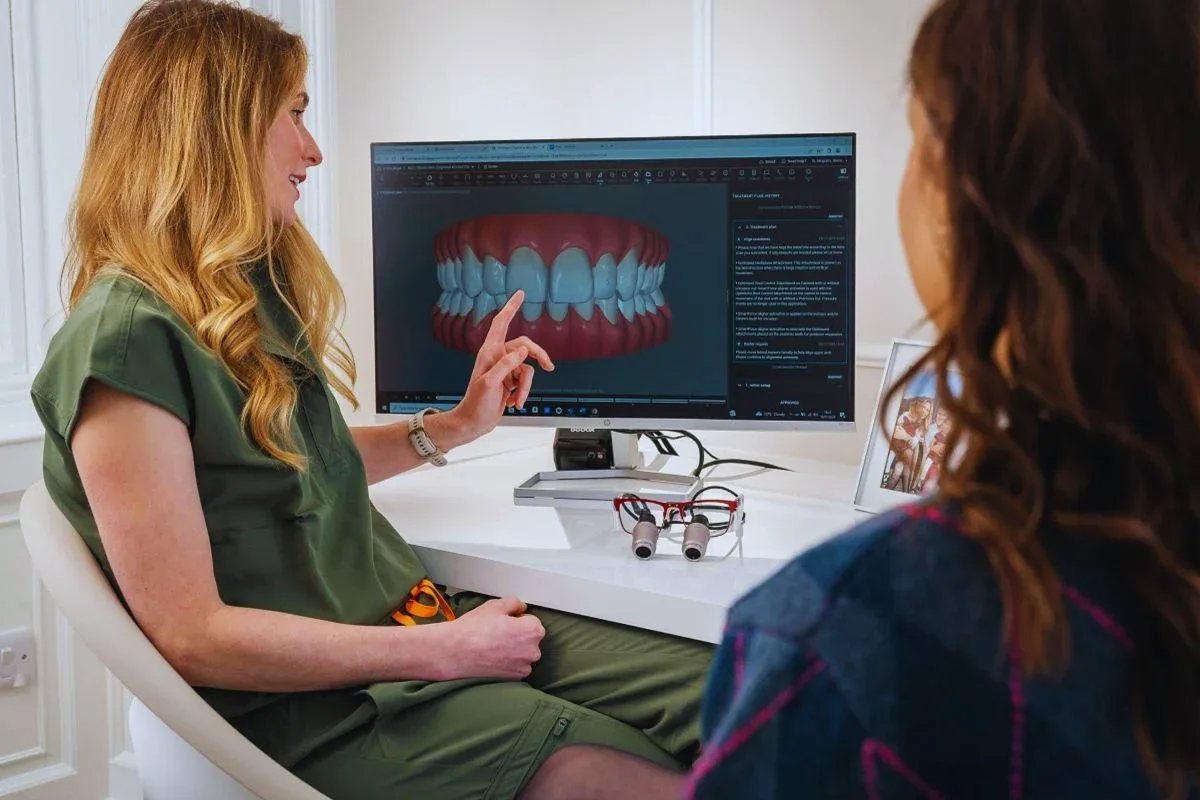
If you are comparing All-on-4 and dentures, the main difference is rather straightforward. All-on-4 is a fixed, implant-supported arch that stays in your mouth permanently. Dentures are removable, either held in place by suction and adhesive or snapped onto implants, but they are still taken out for cleaning. Both replace a full arch of missing teeth, but they differ in stability, maintenance, cost, and long-term bone support. At Dean Dental Solutions in North Little Rock, the right fit depends on your bone density, health history, budget, and what matters most to you day to day.
Jump to Section
Understanding Your Options: All-on-4 vs. Dentures
While traditional or snap-in dentures are a common removable option for tooth replacement, All-on-4 is a fixed, full-arch prosthetic that does not come out.
Both replace a full arch of missing teeth. Both can restore your ability to eat, speak, and smile with confidence. But the experience of living with each one is genuinely different, from what the process looks like to what maintenance feels like to what you notice (or don’t notice) day to day. That’s where the real comparison happens, and it’s the starting point for making the right call for your situation/preference.
| All-on-4 | Traditional Dentures | Snap-In Dentures | |
|---|---|---|---|
| Fixed or removable | Fixed permanently | Removable | Removable |
| Bone stimulation | Yes | No | Partial |
| Adhesive needed | No | Sometimes | No |
| Procedure | Surgical | Non-surgical | Minor surgical |
| Diet restrictions | Minimal | Common | Some |
| Long-term jaw health | Preserved | Bone resorption continues | Limited stimulation |
What To Know About All-on-4
Most people imagine implants as individual replacement teeth, one at a time. All-on-4 is different. Four titanium implants, placed at precise angles in the jawbone, support an entire arch of teeth as a single, fixed unit. It doesn’t come out. Not for cleaning, not for sleeping, not ever. That permanence is what surprises patients most. Over several months, the implants fuse with the bone through osseointegration, and once that’s complete, they work like natural tooth roots. You eat, talk, and laugh without thinking about your teeth falling out.
This tends to be the right conversation for patients who are dealing with significant tooth loss, teeth that are failing, or years of managing with dentures and wanting something more permanent. There’s also a long-term health dimension worth understanding: because the implants stimulate the jawbone the way natural roots do, they help preserve bone density over time. Without that stimulation, the bone gradually shrinks. All-on-4 addresses that at the source. Our incredible team at Dean Dental Solutions offers full-arch restorations and will walk you through the process from your first appointment onward.
What To Know About Traditional Dentures
Dentures have been around long enough to prove they work. For patients who need full tooth replacement, they remain one of the most appropriate and time-tested paths available, and there’s nothing second-rate about choosing them.
They sit on the gums and stay in place through suction or dental adhesive, and they’re removed for cleaning. That part is straightforward. What takes more adjustment is the ongoing fit. After tooth loss, the jawbone gradually changes shape, which means the gum ridge shifts over time. Dentures that feel right at first may need relining or refitting as those changes accumulate. Eating certain foods also requires more attention, at least until you find your rhythm. Some patients get there quickly; others need more time.
When surgery isn’t the right fit, whether because of health history, insufficient bone volume, or personal preference, traditional dentures are a legitimate long-term solution. They can also serve as a practical bridge while you continue weighing other options. For plenty of people, they’re not a temporary measure or a compromise. They’re simply the right answer.
What To Know About Snap-In Dentures
Snap-in dentures borrow from both worlds. They’re removable like traditional dentures, but they anchor onto two to four implants placed in the jawbone. That anchoring changes the experience considerably.
The implants act as fixed points. The denture clicks onto them and stays. Throughout the day, there’s far less movement: far less slipping, far less second-guessing your teeth mid-conversation. Most patients take them out at night for cleaning, so they do come out. But wearing them during the day feels considerably more secure than traditional dentures, without the shifting and movement that full removables tend to cause.
Who’s this option for? Patients who want more stability than traditional dentures offer but aren’t ready (or aren’t candidates) for something fully fixed. If you want teeth that stay in and function more like your natural ones, All-on-4 is the better fit. But snap-in dentures occupy a real and useful middle ground for a lot of people. Understanding how all three approaches differ in daily life, cost, and long-term bone health is where the real decision starts to take shape.
The Key Differences That Matter Most
The fundamental distinction is straightforward: All-on-4 implants are anchored permanently into the jawbone, where they function like natural teeth, while dentures are removable prosthetics that rest on the gums or snap onto implants. But that single difference in how they attach affects almost every area of daily life. What you can eat, how your jawbone and facial structure hold up over years, and what your morning routine looks like: all of it traces back to whether your teeth are fixed in place or removable.
Stability and Bite Force
All-on-4 implants fuse directly to the jawbone through osseointegration. Osseointegration in dentistry is when the jawbone directly attaches to a titanium dental implant, providing a stable base for artificial teeth. Once healed, the arch doesn’t shift, slip, or click. Patients routinely report being able to eat foods they had avoided for years: apples, steak, crusty bread. Bite force returns close to what natural teeth provide, and most people stop thinking about their teeth at the table entirely.
Traditional dentures rest on the gums and rely on suction, adhesive, or both to stay put. Movement is possible, particularly as gum tissue changes over time. Many patients quietly begin editing what they eat and where they eat it. Snap-in dentures offer greater stability than traditional dentures, but the prosthetics can still lift slightly during certain movements.
For many patients, concern about a denture shifting mid-meal is exactly what makes All-on-4 worth the conversation.
Do Dentures Restrict What You Can Eat?
Yes, traditional dentures do come with real dietary limitations. Hard foods like raw carrots or tough meats can dislodge them, and sticky foods can pull them loose. Snap-in dentures handle more variety, though some patients still avoid anything requiring sustained chewing force. All-on-4 implants, once fully healed, open up a much broader diet with very few food-related restrictions.
Bone Health Over Time
Natural tooth roots do more than hold teeth in place. Every time you chew, they transmit force down into the jawbone, and that stimulation signals your body to keep producing bone tissue. Lose that signal, and the jaw begins to resorb, slowly shrinking in volume and density.
Dentures sit above the gumline and do nothing to slow that process. The bone underneath keeps resorbing at its own pace. Over the years, that shows up: the jaw narrows, the lower face can look sunken, and the denture that fit well at first starts to loosen because the bone it was fitted to has changed shape, often prompting more refitting appointments than patients anticipated.
All-on-4 implants address this directly. The titanium posts act as artificial roots, transmitting force into the bone with each bite, and your jaw responds the same way it would with natural teeth. That preserved stimulation protects the shape of your lower face and keeps the implant fit and stable over the long term.
The healing period after All-on-4 placement, typically several months, isn’t a drawback. It’s the process working exactly as it should. Your body is fusing the titanium posts into the bone, building a foundation meant to hold for decades.
Maintenance and Daily Life
All-on-4 implants stay in around the clock, and caring for them looks a lot like caring for natural teeth: twice-daily brushing with an implant-safe brush, flossing around the arch, and routine professional cleanings at Dean Dental Solutions. No soaking, no adhesive, no removing anything before bed.
Dentures require a different daily routine. Traditional dentures are removed at night and soaked in a cleaning solution, and many patients use adhesive during the day to improve the fit. Snap-in dentures are removed for cleaning as well, though the process is simpler than with traditional dentures.
And look, neither routine is unmanageable. Plenty of people wear dentures for years and settle into the rhythm just fine. But some folks find the adhesive or the nightly removal genuinely tedious over the long haul. It’s worth being honest with yourself about what you’ll actually stick with, because with either option, consistent care is what determines how well things hold up.
How Long Does Each Option Last?
All-on-4 titanium implant posts are built to last decades. Titanium integrates with living bone in a way that, with proper care, rarely requires replacement. The prosthetic arch on top may need adjustment or eventual replacement as normal wear accumulates, and that’s expected. But the implants themselves are a long-term foundation.
Traditional dentures typically need refitting every few years as the gum and bone change beneath them, and most patients replace them entirely every five to ten years. Snap-in dentures follow a similar replacement timeline for the prosthetic, though the implant posts themselves can last much longer.
Over a twenty-year period, the cumulative cost of denture replacement and refitting often narrows the gap with the higher upfront investment of All-on-4. Longevity in either case depends significantly on consistent care: at-home hygiene and regular visits to Dean Dental Solutions for professional cleanings and monitoring.
How Much Does All-on-4 Cost Compared to Dentures?
All-on-4 dental implants come with a higher upfront cost than traditional dentures, and for many people that number is the first thing they see. It can feel like the conversation is over before it starts.
But the upfront price doesn’t tell the whole story. Dentures come with ongoing costs that aren’t always visible at the outset: daily adhesives, periodic relining as the jawbone changes over time, and full replacement every five to ten years. All-on-4 works differently. Once the implants are placed, there are no recurring expenses of that kind. When you do the math across a decade, the gap between the two options tends to narrow significantly, and in some cases, All-on-4 turns out to be the more economical path in the long run.
Cost is one of the first things the team at Dean Dental Solutions addresses. Before any commitment is made, they’ll sit down with you and go through what treatment would actually look like for your specific situation, including a realistic picture of the numbers involved rather than a generic ballpark. For patients who need help making treatment financially workable, there are several options available: the in-house Wellness Club membership plan, CareCredit, and flexible payment arrangements that can bring the monthly cost into a more manageable range.
Does Insurance Cover All-on-4?
Depends on the plan. Some dental insurance policies will pick up part of implant-related treatment. Others call it cosmetic and exclude it entirely. There’s no universal answer here, and the only way to know what applies to your situation is to actually pull up your benefits and look.
That’s something the team at Dean Dental Solutions handles directly with patients. They’ll go through what your plan actually covers, where financing can fill the gaps, and what you’re realistically looking at out of pocket. Talk to the team before assuming the cost puts it out of reach.
Which Option Is Right for You?
There is no feature comparison that settles this. Bone density, overall health, how you live day to day, and what matters most to you all shape what actually works for your mouth specifically.
All-on-4 requires enough jawbone to anchor the implants. Some patients who have experienced bone loss still have paths forward, and that is a distinction worth holding onto. A lot of people walk in assuming bone loss has disqualified them and find out they have more to work with than they expected. Grafting can sometimes rebuild enough structure to support implant placement, depending on what is there and what is going on overall. Earlier evaluation generally means more options are still on the table, so if you have been in dentures for a while, getting your bone density looked at sooner is worth doing. The answer may surprise you.
Dentures tend to make more sense for patients who are not ready for surgery, who have health conditions that complicate implant placement, or who want a lower-commitment starting point before doing anything permanent. And dentures are not a consolation prize. Plenty of people wear them comfortably for years. The real measure is simpler than people think: which option lets you eat, speak, and smile more comfortably? That answer is different for everyone, and no article can hand it to you.
A clinical team that’s looked at your scans, talked through your history, and actually knows what you’re working with can get you a lot closer to a real answer than any article can.
Can I Switch From Dentures to All-on-4 Later?
A lot of patients do make that switch. The main thing standing between dentures and implants later on is usually what has happened to the jaw in the meantime. Once natural teeth are gone, the jawbone starts to resorb. It is gradual, but it is consistent. Dentures sit on the gum surface and do not do anything to slow that process down. So the longer someone has worn them, the more bone may have been lost, and that affects whether implants are still a realistic option.
Bone loss doesn’t automatically take All-on-4 off the table, but it does affect what’s still available to you. Earlier is genuinely better here, not because the team is trying to rush you, but because the window of options can narrow over time. If you want an honest read on where things stand right now, that’s exactly what the team at Dean Dental Solutions does. No upsell, no pressure. Just a real look at what’s realistic for your situation.
What To Expect When You Come In
A consultation at Dean Dental Solutions is a conversation, not a sales pitch.
You’ll start by talking through your goals and what’s been holding you back, whatever that looks like. Maybe it’s cost. Maybe it’s nerves. Maybe you’ve just been putting it off. Then the team takes a real look at what’s going on: bone density, gum health, the overall condition of your mouth. Not in a clipboard-checking, clinical kind of way. More like someone who’s trying to actually understand where you’re starting from. By the end of that first visit, you’ll have a treatment plan you can follow, with the numbers explained in plain terms and nothing left floating.
One of the things patients most want to know before they commit is how much it’s going to hurt. The honest answer is that most people are surprised by how manageable it is. The procedure is done under local anesthesia, and sedation is available for patients who want it. There will be some soreness and swelling in the days afterward. That part is real. But the level of pain most people are imagining going in? Usually not what they experience. Before you move forward with anything, the team will walk you through exactly what healing looks like so you’re not going in without a clear picture.
Most people are surprised to find out they’re not leaving surgery day empty-handed. A provisional arch goes in the same day, so you walk out with teeth already in place. The full process does take several months from implant placement through final restoration, because the implants need time to properly fuse with the jawbone. But everyone’s timeline looks a little different, and your consultation will map out what that actually means for you specifically.
The team has been doing this in North Little Rock for more than 30 years. In that time, they’ve worked with a lot of people who waited because they were embarrassed, because they’d already decided it was too expensive without ever asking, or because a rough experience somewhere else made them hesitant to try again. They’ve heard it before. There’s no judgment here.
Nobody walks out of that appointment feeling like they’ve been sold something. The purpose of the visit is to give a real, honest look at what’s possible, what it costs, and what the next steps would be if someone decides to move forward. There’s no pressure to decide anything on the spot. That part is entirely up to the patient.
When you’re ready to have that conversation, you can request an appointment at deandentalsolutions.com/request-appointment/.
All-on-4 and Dentures at Dean Dental Solutions
The decision really comes down to one practical question: do you want teeth that stay in permanently, or teeth you can remove to clean? Either path can give you back the ability to eat comfortably, speak clearly, and smile without hesitation. Which one actually fits depends on your health history, the condition of your bone structure, your budget, and what you need most from your day-to-day life.
The team at Dean Dental Solutions in North Little Rock has walked people through this decision for over three decades. Patients come in from Sherwood, Jacksonville, Maumelle, and all around the area, and a lot of them are here because someone they trusted had a good experience and passed the name along. That kind of reputation takes time to build. They’ve put in that time.
A lot of people sit on this for a while before making an appointment. That’s completely understandable. It’s not a small thing to decide between dentures or implants. Whenever you’re ready to have the conversation, we’re ready to have it with you. Come in curious, come in skeptical, come in with a list of questions you’ve had for two years; it truly doesn’t matter. Our talented dentist will give you straight answers, not a sales pitch. That is our promise.
Main Office: 501-214-4056
West: (501) 443-7833
Request an Appointment: deandentalsolutions.com/request-appointment/
Hours: Mon-Thu 7am-4pm | Fri 7am-1pm


Leave a Reply